"Don't do it!"
Far too often this is the rote response from a colleague or hospitality-food & beverage professional/expert when approached by someone seeking advice:
"Do you have any suggestions for someone who is looking to get into the restaurant industry?"
"Don't. Do. It!"
These are the same people that will usually lament that there are no good applicants for vacant jobs, whinging about staff shortages and the lack of training for the staff that do eventually show up at the back door. There may be an easy solution to this problem: we should work hard to make people want to join the hospitality industry instead of scaring and steering them away.
The number of people whose first job is in the hospitality industry is over 30%, and it is consistently one of the industries that employs the most people in this country. So why is it that we have staff shortages? It seems like the jaded old-timers are focused solely on the negatives of the industry, and won't even allow new employees the time and space to figure out if they like the work, and the culture, on their own accord.
I know that it is hard. It is hard work. It is hard on a person both mentally and physically. It is hard on sobriety. It is hard on relationships with anyone outside of the industry, including spouses, children, friends...acquaintances.But these same challenges can pay huge dividends as well: it is an industry that opens the world up for you to travel in, the typical hours of restaurant work open your schedule for other creative endeavours and taking advantage of the "gig economy" during your off-hours. You will learn valuable skills, (cooking, interpersonal communication, problem solving, critical thinking, inventory control, purchasing, merchandising, marketing, promotions, time management), many of which you will use daily for the rest of your life, regardless of your final career path.
Chef Gary Hunter, Vice Principal for Hospitality and Adult Learning at London's Westminster Kingsway College laments the lack of new entrants into the field despite the popularity of TV cooking shows. As a professional educator, he has a simple three-part plan to attract new employees which includes the embracing of apprenticeship programs, and putting potential employees into paid/real-world-experience positions. Get them into restaurants, hotels, and clubs and let them see, first-hand, how rewarding--and challenging--a career can be.
And just because someone isn't a "hard body," or they don't have that slightly masochistic personality, or they have a different career in mind doesn't mean that we should close the door to entry before they've crossed the threshold. In fact, some of the best cooks I have ever employed were merely "passing through," and were working to get through college, or figuring out what they wanted to be when they grew up. Yes! This was frustrating at times, hopefully they will look back on their time with me and say that it was valuable in one way or another (beyond a pay check or lift pass). These employees are just as vital to the continued success of the industry, and we shouldn't pass them over. Hopefully, they will work for you and think, "hey! This is pretty cool" and end up spending more time than they had planned in hospitality, or even ultimately make it their career (which is exactly what happened to me!)
And I think we can all agree that there are some challenges to being a hospitality industry employee that are challenging; these shouldn't be exaggerated to hyperbole or sugar coated. And the benefits are myriad, and these too should be delivered in a realistic and measured way. This honesty and transparency will both attract and repel, we just need to be collectively smart enough to welcome those that are attracted into the fold.
Showing posts with label Chef. Show all posts
Monday, April 2, 2018
Monday, March 20, 2017
Putting the work in
It's springtime, and a chef's fancy turns to mentoring; specifically through judging state-level/high school ProStart culinary competitions. In the course of seeing 100's of young cooks cooking I was reminded of the beginnings of my career and my apprenticeship. I am also reminded of my overblown sense of self-worth which cost me the opportunity to work for a highly regarded, award winning chef, and how I must have looked to people who interviewed me for a job.
After completing my apprenticeship I moved to Arizona and embarked upon my first job search in five years. It took a while to gain traction, but I remember getting some okay responses, finally landing a position with a nationally flagged hotel chain; which I subsequently quit because the position was "below me and not what I want to do with my career," (I was subsequently rehired with a promotion and a raise).
As I worked in the hotel's banquet kitchen I convinced myself that I should be a sous chef/executive chef somewhere else, and within six months I filled every day off I had looking for a new job. Not surprisingly, (ok, in actuality--and looking back, I had NO reason to expect call backs, let alone interview for anything more than a line cook position), I was getting called in to several restaurants to interview for sous chef positions.
My ego was enormous!
I would tell potential employers during my first interview that I would not do huge, lengthy prep tasks. I would refuse to work certain days. Every answer in an interview I gave then, are the exact same answers that would stop a potential cook's interview to work for me, now, before it started! Not surprisingly...I remained at the hotel as a banquet cook; no one was hiring me to be their sous chef.
"Their loss..."
Then one day I got a phone call for an interview for another sous chef position. But this was not an average sous chef position. This was for the OG chef in town. One of the early practitioners of Southwestern Cuisine. A contemporary of Fearing and Miller. A James Beard Award winner. An early champion of exploring and resuscitating the lost indigenous foodways of his surrounds.
JACKPOT!
I headed off to the interview. I arrived and was welcomed into the restaurant by the chef de cuisine, and met The Chef. I answered some preliminary questions, and was dispatched to do a bench test in what could be best described as a garage off of the chef's office kitted out with plastic folding tables to prep on.
I gladly and cheerfully embarked on the tasks set before me. When I was done, Chef came out to talk to me. He thanked me for coming in and that he enjoyed meeting me...but I wasn't going to get the sous chef job. He did offer me a job as a line cook, a position which he was not hiring for previously, and was creating solely to bring me onto his team...which I turned down out of hand.
I'm a SOUS CHEF, damnit!
It would be another two-years before I would be offered, and accept my first sous chef position. Two-years of hard work, learning, college classes, staging, volunteering for opportunities to work with other chefs for free, reading every cookbook and culinary magazine I could get my hands on...
Seven-years after my interview with The Chef, I found myself in his dining room, in his newly-custom built restaurant; I was a chef myself by this time. He came to the table; sat with us and discussed the menu. Asked my date and I what our wine preference was and recommended, (and comped), a bottle of his favorite wine. He was cordial far beyond standard professional courtesy.
He sent a message without saying a word.
Now, as I mentor cooks and chefs I can't help but relate my experiences as I help them navigate their own career paths. There are no shortcuts, and they need to live a purposeful life; knowing that every move they make today needs to be moving them closer to their ultimate goal. Be humble and never turn down an opportunity to learn. When it's your time, and it will come, you will know; be patient but be continually working towards where you want to be.
Put the work in.
Tuesday, April 5, 2016
The Hiatus
(Disclaimer: I share the opinion of A-Rod that is held by nearly all Boston Red Sox fans. Mea culpa.)
Yesterday I listened to an interview with Alex Rodriquez on Mike & Mike and at one point he started speaking about his "hiatus" from baseball in 2014. He addressed that his career was on a downward trajectory and after sitting out a year he feels better than he has in over a decade. And as he spoke of professional rejuvenation and fresh starts something resonated with me. Shudder to think it, but I knew exactly what he was talking about.
Let me start by saying that I am not on a hiatus; I still cook for a living. However it does feel like I am on a hiatus, as I am not currently working 80-plus hours a week and I actually spend time at home and with friends and family. My days no longer start before the sun comes up only to end long after the sun has set in the west; I actually get to see my daughter off to school and tuck her in at night--things most people take for granted but I had not done with any regularity for the better part of ten years.
I have a dream job--a literal 1-in-43-opportunity-of-a-lifetime. Although I no longer work everyday, I work for very intense, relatively short periods of time. I am grateful for the opportunity, my boss, and the freedom that both allow me with this job.
So how does this all tie into the concept of being on hiatus?
For me it all revolves around my new found "down time." For the first time in...I'm not sure when I was last able to do the kind of introspection I have been able to do recently. I find myself being "judgy" towards actions of colleagues, but in a positive--and private--way; in a way that is helping me to see my own shortcomings--hopefully positioning myself to ditch them--and eliminate or correct them, (or at worst, live with them). By recognizing my foibles in others, I am acquiring the mental skills to be a better chef.
I also have the luxury of sitting on the fringes of the food and beverage industry and being able to see into the industry with a pair of refreshed eyes. All I can say, is that it is true that you can sometimes be so close to the forest, that you cannot see it through the trees.
The heightened self awareness that comes from being "removed" from the day-to-day grind of 12-hour+ days cannot be underestimated either. This is one of my favorite benefits of my current situation. I am able to think about how restaurants operate, kitchens are designed, staff is hired and trained, and ponder alternate methods of doing all of the aforementioned actions--all without being encumbered with having to go do dishes because the steward call in sick, or vacuum the dining room because the staff is shorthanded. I am able to develop a better way of doing things in the vein of: if I could "do anything I want" within a restaurant.
Of course, with all of this freedom of time and thought comes a downside. Because I DO sit on the outside looking inward, I am not playing reindeer games anymore. As I champion my colleagues in their successes, charitable endeavors, pursuit of--and acceptance of--national acclaim and awards, I am no longer pursuing those same goals, and in some cases I am ineligible to. I am operating in a world of self-imposed professional exile; yes, I do still cook to make a living, BUT I am out of the public eye and my eligibility to be regarded as "one of the guys" has been revoked, (driven home when I submitted a request for a range of samples from a manufacturer and I was told I couldn't have them because I was no longer 'serving the public.') I have eaten my share of crow and humble pie while having my ego checked on a daily basis.
But once I take the ego out of the equation, I begrudgingly admit I am refreshed--both mentally and physically. The time away from the line and a brigade have really been good for me, (i only used vacation time in previous positions because I was forced to...I have a super-high old school-blue collar work ethic ingrained in me). To be able to step away, while at the same time keep my toes in the water of the industry as a whole, has been a blessing--more than it has been a curse, I assure you. And, yes...I have developed some great new ideas and systems for operating my pie-in-the-sky-maybe-someday-restaurant; I am able to escape the tyranny of "we do it that way because that's the way we have always done it."
At the end of the day, I am glad that with my current "break" from the day-to-day restaurant hustle I have exchanged the pursuit of fame and glory for myself, for the opportunity to meet Joolz when she gets off of the bus in the afternoon.
Wednesday, January 27, 2016
Mise en place! Mise En Place!! MISE EN PLACE!!! pt. 2
It was a lonely walk to the South Side of Syracuse. One where my anger had slowly become self-loathing. In the course of 6-hours I had gone from being, (at least what I perceived), "The Chosen One" to a cook not worthy of preparing family meal. In my mind I was sunk. Time to move on, but where? By the time I arrived home I was emotionally drained, and had beaten myself up pretty badly. I went to bed hoping that things would "sort themselves out" in the morning.
The next morning I woke up. The sun was shining. I was still a shite cook. Almost three years gone of my apprenticeship, nearly 5-years into my cooking career and I. Was. Shite.
I threw some ska on the stereo, turned it up so that I could hear it outside, and headed to the picnic table in the front yard armed with coffee, cigarettes, pen and paper to figure it out. Smoking cigarette after cigarette, I stopped feeling sorry for myself, and turned my venom outward.
"[Bleep], Chef!"
"[Bleep] that place!"
"I don't need to put up with that kind of verbal assault!!! [Bleep]!!! Him!!!"
And then, without even realizing it, I turned the corner. I was going to work tomorrow, Thursday. If I didn't, Chef would beat me. And there was NO WAY he was going to beat me! And then I realized he may have been right about me.
Both that I was a colossal screw up, and that I deserved that shot at a Tuesday night shift.
Up until this point, I had survived my apprenticeship as the comedic foil to the chef, as well as by being THE grammar/spelling resource of the kitchen. And I did have some average cooking chops at that point. The day before had really driven home the point that the truth hurts. I was not ready for service, and what I thought was mise en place wasn't close to actual mise en place.
The Chef could do 25 covers working out of a cooler with one arm tied behind his back because he could, after years of training. There was no way I could do that then, (I still freak out a little in my head when I have had to cover a line solo).
And like a swift slap to the face, I was enlightened. I truly understood what mise en place was. Not only did it mean making sure I have enough food prepared for my section for service- and this is a huge part of it- it also meant making sure that my bain-marie of utensils was stocked with what I needed for service and in the same place every time, that I wasn't just prepping, but setting myself up for success."Why reach into the cooler every time I need a certain condiment instead of keeping it in an ice-bath on the counter?' "Why not slice and toast my burger buns ahead of time and just reheat them when I needed them?" It all clicked.
There was nothing cool about failing to do my job and set my section up, and let the Chef down. I would rather look like a newbie and have every piece of mise en place in ice-bath at arm's reach to make it through service successfully with satisfied guests and a happy Chef. I was in-it-to-win-it. My days of being the class clown were over, or at least tempered by the fact that i couldn't just coast by anymore. I was about to be dumped out of the nest and I needed to get. It. Together.
As I walked to work on Thursday I spent the majority of my time thinking about what, and how, I would do things differently. To make things right; and I made a decision that I was going to do it "the right way" every time for the rest of time.
I slunk in the kitchen door that day, hoping to avoid Chef at all costs. He saw me. But, it was never spoken of again, and I know that the fact that I returned to work, (early for my shift even), earned me some respect and credibility from Chef and all of the other cooks who had already heard about my epic ass-chewing!!!
The lesson learned was that mise en place is EVERYTHING when setting yourself up for success. Most of us keep absolutely meticulous lists of the minutia needed to run our sections down to filling the salt and pepper grinders. From the outside I'm sure it looks like cooks have Obsessive-Compulsive Disorder, put without obsessively making sure that every food item, no matter how trivial, is prepared, or making sure that the fish spatula is where the fish spatula belongs in the bain marie the "wheels would come off" during service.
And take it from me that that is NOT what you want to have happen as either a guest or a cook.
Thursday, January 21, 2016
Mise en place! Mise En Place!! MISE EN PLACE!!! pt. 1
Mise en place is a fairly common term in kitchens: literally "put in place," it is an essential ethos for making sure that your section is prepared, physically and mentally, with all of the necessary ingredients to execute a service in place. A place for everything and everything in its place. I had heard the term mise en place since my days as a dishwasher, so as a cook I was certain I knew exactly how to prepare proper mise en place.
Then one day while still in my apprenticeship, a day that became as pivotal in my becoming a chef as any other -a conscious moment of "this determines what happens from here on out"- I truly learned what mise en place was all about:
My apprenticeship was far more well-rounded than the horror-story-apprenticeships of cooks who did nothing but sit in a basement room and polish copper pans all-day. Or stand in a scullery 16-hours a day peeling root vegetables that would never be used for more than family meal, just to come back and do the same task day-in, day-out, for months on end...with no chance of ever cooking on the line. Wednesday's was a heavy prep of mise en place for the garde-manger station for the week and working the occasional cold garde-manger shift on the line. Thursdays and Fridays were prep and private events. Saturdays were almost always weddings, the ilk of which featured florist bills that eclipsed my yearly earnings. Sundays and Mondays were taken up by brunch, prep, and either private or charity events for well over 300 guests. And then there was Tuesday.
Tuesday night was the "prestige" shift for the young commis and chefs de partie. It was the night when you worked the a la carte line solo. No Executive Chef. No Sous Chefs. No safety nets. No one else except for a bartender to take food orders and run food. It was a young cook's chance to prove to the Chef that they were ready for bigger tasks and to be trusted on the dinner line as more than a "salad shooter."
In retrospect, we probably made a lot more out of it than it was. The menu was reduced to the Grille Room Menu: sandwiches, salads, and foods of the "fryo-lated" arts for simplicity of prep, execution, and clean-up...and minimizing our chances of screwing it up. Rarely, if ever, did we serve more than 15 guests between 4:30 and 9:00 PM. For these reasons it was the one shift of the week that the Chefs were guaranteed to have off. It was idiot proof.
I finally got my shot at a Tuesday night shift somewhere in the last year of my apprenticeship. When I arrived the Sous Chef, Jeff, was getting ready to leave for the day. He gave me a brief rundown of the lay of the land, pointed out a few small prep items to be completed and then bolted out the back door of the kitchen to enjoy the nearly six-hours of sunlight left in the day.
"I've got this!" I thought as I went about finishing the remaining prep, and setting up my mise en place for service. Now, when I say that I "set up" it would be more accurate to say that I set up the line like the Chef or Jeff would have: very minimally as to facilitate little to break-down/clean-up at the end of the shift. First solo shift, I can show that not only can I hang with the Chefs, I can do it just like them.
As we neared the 4:30 opening time I expected the parking lot that was overflowing with cars would start thinning out, and only the after-work golfers would be left to worry about feeding. Two things I failed to recognize or take into account: 1) the main reason guests didn't come in to eat on Tuesday nights was because the Chef and Doug weren't there and they were loathe to be fed by the likes of me, 2) the Chef WAS there this Tuesday for meetings, menu consultations with future brides, and essentially making busy-work for himself in another part of the building to be my lifeline, but just far enough away so as not to destroy my (over)confidence by seeming like he didn't trust me with his baby.
And because Chef was there, and parked out front of the club house so that I wouldn't see his car, most of those members and guests who would have headed home, or away from the club at the very least, decided to have the Chef cook them dinner this particular Tuesday night. Right from "Jump!" I was in the weeds. I was not even remotely organized enough to be considered disorganized. I had Z-E-R-O real mise en place on the line. I was clown shoes. I was going down, and quick...
And then Chef came through the swinging doors, I must have looked relieved, and given the hint of a "phew! The cavalry is here!" kind of smile, and I watched Chef put an apron on over his street clothes. What came next was awful.
While I know the gist of the message was about me not knowing what mise en place means/how to prepare mise en place/where is your mise en place?, I can not to this day remember the exact words that were hurled at me that night.
My Chef, my mentor, my friend, was tearing me a new orifice with the kind of veracity and ferociousness I had only heard from sports coaches during my youth. But this was expletive laden. Surgically taking me apart word-by-word. Hours long, and 100% accurate. I was cooking with both my head and my tail between my legs-on the verge of tears-and with only my stubbornness keeping me from walking off of the line and out of that kitchen, (honestly, I had watched a recent graduate of the Culinary Institute of America get kicked off the line the previous winter, and I knew that if I left the line- let alone the kitchen- it would only make it worse). As the orders fired out of the printer it seemed as if Chef's tongue lashing only intensified. After the longest service of my young career, it was over. Everyone was fed and the parking lot started to empty. I had survived, even if I had been screamed at maniacally for the last 3-hours.
I was feeling low. My confidence was beyond shaken; it didn't exist anymore. As a parting jab, as Chef threw his apron into the linen bag, I was told to make sure I left the place spotless AND to take the next day off.
BOOM. Being given the day off like that was essentially telling me to eff-off down the road without actually firing me, and I knew it. I had seen it before. As I licked the wounds from my first solo service, I was feeling equally sorry for myself and pissed off at the Chef. I mean, we had done 75 covers on a night when 12 would have been "busy."
After making sure that the quarry tiles under the equipment had been mopped, and that every inch of stainless steel had been scrubbed I made my way to the locker room. I hurriedly changed, and slunk out the back door; cutting across fairways and greens on my walk home...chain smoking and planning my early exit from my apprenticeship the entire way.
Then one day while still in my apprenticeship, a day that became as pivotal in my becoming a chef as any other -a conscious moment of "this determines what happens from here on out"- I truly learned what mise en place was all about:
Tuesday night was the "prestige" shift for the young commis and chefs de partie. It was the night when you worked the a la carte line solo. No Executive Chef. No Sous Chefs. No safety nets. No one else except for a bartender to take food orders and run food. It was a young cook's chance to prove to the Chef that they were ready for bigger tasks and to be trusted on the dinner line as more than a "salad shooter."
In retrospect, we probably made a lot more out of it than it was. The menu was reduced to the Grille Room Menu: sandwiches, salads, and foods of the "fryo-lated" arts for simplicity of prep, execution, and clean-up...and minimizing our chances of screwing it up. Rarely, if ever, did we serve more than 15 guests between 4:30 and 9:00 PM. For these reasons it was the one shift of the week that the Chefs were guaranteed to have off. It was idiot proof.
I finally got my shot at a Tuesday night shift somewhere in the last year of my apprenticeship. When I arrived the Sous Chef, Jeff, was getting ready to leave for the day. He gave me a brief rundown of the lay of the land, pointed out a few small prep items to be completed and then bolted out the back door of the kitchen to enjoy the nearly six-hours of sunlight left in the day.
"I've got this!" I thought as I went about finishing the remaining prep, and setting up my mise en place for service. Now, when I say that I "set up" it would be more accurate to say that I set up the line like the Chef or Jeff would have: very minimally as to facilitate little to break-down/clean-up at the end of the shift. First solo shift, I can show that not only can I hang with the Chefs, I can do it just like them.
As we neared the 4:30 opening time I expected the parking lot that was overflowing with cars would start thinning out, and only the after-work golfers would be left to worry about feeding. Two things I failed to recognize or take into account: 1) the main reason guests didn't come in to eat on Tuesday nights was because the Chef and Doug weren't there and they were loathe to be fed by the likes of me, 2) the Chef WAS there this Tuesday for meetings, menu consultations with future brides, and essentially making busy-work for himself in another part of the building to be my lifeline, but just far enough away so as not to destroy my (over)confidence by seeming like he didn't trust me with his baby.
And because Chef was there, and parked out front of the club house so that I wouldn't see his car, most of those members and guests who would have headed home, or away from the club at the very least, decided to have the Chef cook them dinner this particular Tuesday night. Right from "Jump!" I was in the weeds. I was not even remotely organized enough to be considered disorganized. I had Z-E-R-O real mise en place on the line. I was clown shoes. I was going down, and quick...
And then Chef came through the swinging doors, I must have looked relieved, and given the hint of a "phew! The cavalry is here!" kind of smile, and I watched Chef put an apron on over his street clothes. What came next was awful.
While I know the gist of the message was about me not knowing what mise en place means/how to prepare mise en place/where is your mise en place?, I can not to this day remember the exact words that were hurled at me that night.
My Chef, my mentor, my friend, was tearing me a new orifice with the kind of veracity and ferociousness I had only heard from sports coaches during my youth. But this was expletive laden. Surgically taking me apart word-by-word. Hours long, and 100% accurate. I was cooking with both my head and my tail between my legs-on the verge of tears-and with only my stubbornness keeping me from walking off of the line and out of that kitchen, (honestly, I had watched a recent graduate of the Culinary Institute of America get kicked off the line the previous winter, and I knew that if I left the line- let alone the kitchen- it would only make it worse). As the orders fired out of the printer it seemed as if Chef's tongue lashing only intensified. After the longest service of my young career, it was over. Everyone was fed and the parking lot started to empty. I had survived, even if I had been screamed at maniacally for the last 3-hours.
BOOM. Being given the day off like that was essentially telling me to eff-off down the road without actually firing me, and I knew it. I had seen it before. As I licked the wounds from my first solo service, I was feeling equally sorry for myself and pissed off at the Chef. I mean, we had done 75 covers on a night when 12 would have been "busy."
After making sure that the quarry tiles under the equipment had been mopped, and that every inch of stainless steel had been scrubbed I made my way to the locker room. I hurriedly changed, and slunk out the back door; cutting across fairways and greens on my walk home...chain smoking and planning my early exit from my apprenticeship the entire way.
Tuesday, November 26, 2013
To brine, or not to brine...
You are responsible for the spread, the house is a mess, family needs to be picked up at the airport...AND you're supposed to present an elaborate buffet whose excess would make Squanto blush.
At this moment, I would implore you to think like a chef. Delegate the cleaning and the execution of livery services to the kids, friends, neighbors...focus on what is really stressful: cooking for 20-plus people.
I remember my Grandma cooking on Thanksgiving, everything made from scratch, and all made on Thanksgiving except for the pies...
Then I started working in professional kitchens and was blown. Away. There was no last minute struggle to produce the meal for several hundred people! I love my Grandma, loved her cooking (an immeasurable influence on me as a chef), but, boy, oh, boy was she going about it the hard way!
Now, decades later, when I teach cooking classes or am asked about Thanksgiving dinner, I give the wry "think like a chef" answer as the key to success. So...just what does that mean? It means planning ahead. Write your menu down, determine what you can do ahead of time that can be frozen, (desserts), or days ahead and refrigerated, (cranberry sauce, vegetables prepped for cooking). As a chef I live and die by my daily preplists which include the big projects like "peel potatoes for mashed potatoes" to the minute, "chiffonade sage for gravy." The more of the advance work you can do before Thursday, the easier/more relaxing/successful your Thursday will be. (And, foods like stuffing are WAY more delicious if you make it days ahead and let the flavors develop in fridge...and then all you have to do is re-therm the stuffing on Thanksgiving).
Now, one of the big bones of contention amongst professionals is do you brine your turkey? Some will say that if you do this, that, and the other thing you don't need to brine your turkey. I am a full-on convert to the brining of turkey! I like to break a turkey down and remove the breasts and legs from the carcass. (This method provides myriad advantages: you can now use the carcass to make stock for gravy, stuffing, soup..., the breasts and legs cook at separate rates so you can control cooking better, a broken down turkey will take up less space in the refrigerator and oven, it is much easier to handle on Thanksgiving, AND it will take far less time to cook than a bone-in bird.) Brining produces a flavorful, and moist turkey, (even if you cook it a wee bit longer than you should).
Of course, if you break the turkey down you loose that Norman Rockwellian photo opp with Dad carving the turkey at the table. And yes, it is the Chef's Mantra that if the meat is attached to the bone, cook it on the bone for maximum flavor. I will take an edible turkey over a photo opp any day. And, when you brine your turkey you more than compensate for taking it off of the bone.
I hear the grumbling that it is all well and good in a restaurant kitchen, but at home it such a pain, too messy, blah, blahbitty, blah...there are plastic bags available at the supermarket that made specifically for brining turkeys, people will place the turkey, brine, and ice in a cooler...there was one year when the temperature stayed below 40 F and I put the turkey and brine in a 5-gallon bucket and kept it in my car overnight! Where there is a will...
What about the actual brine? Here is where I encourage you to experiment with flavors, with one exception: the amount of salt. There is a scientific ratio, by weight, (scales are for cooks, measuring cups are for building sand castles), for salt:liquid which is:
1:20; 1-part salt to 20-parts water, or approximately 1-1/4 ounces of salt (by weight) to 1 gallon of water.
You can replace some of the water with wine, brown sugar instead of white sugar...just make sure you taste it before you put your turkey in the brine to make sure it is delicious. I will usually add the salt, water, whole peppercorns, a cinnamon stick, some crushed red chili flakes, sugar/honey, and soy sauce (just enough for some umami) to a pot and bring up to a boil. This helps dissolve the salt, and sugar while extracting flavor out of the spices. After the salt has dissolved I will strain the brine into a clean container and put in the fridge to cool; you can substitute ice for some of the initial liquid to chill it faster (like you did when setting gelatin when you were in a hurry). After the brine is cool, add your turkey parts; I would recommend brining the turkey for 12-24 hours. (If you brine the turkey for any longer than that, you are going to move from "brining" to "curing" and the texture of the turkey will change dramatically (almost to the point of deli counter turkey).)
Cooking you brined bird is easy-peasy: remove the turkey from the brine and pat dry with paper towels. (In a professional kitchen we will do this on Wednesday morning, and place the dried turkey on roasting racks- the ones sold as "cooling racks" in kitchen supply stores- and store them uncovered overnight to really help the skin dry). You want to dry the skin because moisture is the enemy of crispy. We will then roast the turkey at 275 F until an instant read thermometer reads 155 F (usually less than 1 hour); remove the turkey from the oven and cover with foil. (SCIENCE ALERT: This is resting the meat to allow the juices to redistribute back into the turkey; it will allow the turkey to "carry over" cook to the government recommended 165 F; it will allow the proteins to relax making your slices nice and pretty).
So plan ahead. Prepare ahead. And go through Thursday like Martha Stewart has a thing or two to learn from you! And, regardless of whether you brine your turkey whole, break it down and roast the pieces un-brined, or order take-out from from your local restaurant, have a happy and safe Thanksgiving.
Monday, November 25, 2013
Escoffier didn't have to put up with this...
"I am a hotel chef."
That was a big admission for me. And a generalization based upon looking at my resume, (all generalizations are false by the way.) For the sake of this argument, I will accept the label.
I have spent 11 of my 17 years as an Executive Chef in hotels, so I guess it is correct: I. Am. A. Hotel. Chef. "But, why is this such a 'big admission' for you?" you may ask. Well...I have always fought against labels and being pigeon-holed as this or that; as a musician/fan of music I don't like labels...so why would I want to be labeled as chef? There are some who believe that chefs that work in hotels are less talented, don't really cook, and if they were "really that good" they would have a restaurant of their own.
More disconcerting, is the reaction amongst other hospitality professionals and kitchen colleagues. I have gone into job interviews for a "Restaurant Chef" only to be sneered at when the interviewer looks at the resume to only see hotels...despite the fact that in a hotel I run multiple restaurants AND a banquet business AND catering AND room service... Anthony Bourdain has called Hotel Chefs, "sell outs" who cook "schlock food." And while there are definitely those chefs in hotels, I take umbrage to Mr. Bourdain's assertion, and the general perception of Hotel Chefs. AND here is why:

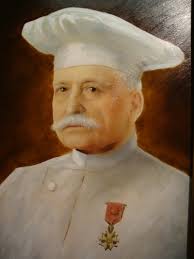
1) It is almost universally acknowledged that Auguste Escoffier, building upon the work of Chef Marie-Antoine Careme, is the Grandfather of Modern Cuisine as we know it. He was referred to as the "king of chefs, chef of kings." The Certified Master Chef Test uses the recipes from Escoffier as the basis of its judging criteria. Almost every kitchen office has a copy of his Le Guide Culinaire. Odd then, that chefs tend to forget that he teamed up with Cesar Ritz, (you may have heard of the Ritz Hotel in Paris...or the Ritz-Carlton...), the most successful hotelier of the era to become the preeminent chef, possibly of all. Time. And even though it is a fact oft overlooked, Escoffier was a Hotel Chef!
2) I realize that a lot of chefs who have no hotel experience, may look down upon a Hotel Chef as "playing it safe" while they are running a restaurant "without a net." Which is fair. Hotels have the "luxury" of having room revenue to offset the costs of the entire hotel; hotel food and beverage operations are often subsidized, and looked at as amenities/loss leaders and not a profit center. A freestanding restaurant, if lucky, will cover all of their costs with their Sunday through Friday sales with all of their Saturday sales being profit. Many are not that lucky...
However, as a "restaurant chef" there is a much higher reward to accompany the much higher risk. If you are a chef in a restaurant and you are a great "Culinary Artist" or are doing something of note, people will. Take. Notice. There is more media attention...which leads to more covers...which leads to more profits...which leads to more and more and more...In a hotel, "high praise" is, "This doesn't taste like hotel food." Regardless of how innovative or delicious your cooking is, the only media coverage you can expect is from trade magazines. AND if you are truly awesome and worthy of a national spotlight, the Corporate Chef of your hotel company will swoop in for the photoshoot...while you toil away in awesomeness and anonymity.
3)There are actually working Executive Chefs that work in hotels!
Seems obvious.
There are many Executive Chefs that follow the somewhat antiquated-traditional model of the Executive Chef who do not cook for a living anymore. They are the chefs that sit in an office, looking out the office window at the kitchen operations. They embrace the Executive part of their title more than the Chef part..."Clipboard Chefs," (labeled as such because they are more apt to be found with a clipboard in their hands instead of a knife or food); it is the stereotype that I fight against everyday.
In the same vein of the somewhat "new school of thought" which sees hoteliers treating their restaurants as Restaurants in a Hotel instead of the staid model of Hotel Restaurants, I consider myself a Chef that works in a hotel more than I would say I am a Hotel Chef. Oh, sure...I can still rock the Hotel Chef paperwork with the best of culinary administrators. And I can multi-task and execute a wedding for 250 people while feeding another 250 people in another dining room.
I just choose to be hands-on. I choose to cook. I would rather help you instead of delegating the task of helping you to someone else. I would rather work on one dish all day until it was "perfect," or I was convinced that it wouldn't work, instead of doing paperwork. I can work your dinner line and still bring in a targeted COGS and write my budget for next year. I guess you could say, that I am a Restaurant Chef, trapped in a Hotel Chef's career path.
4) Although I disagree with the general perception, I can see how we may be viewed as "sell outs" or "prima donnas."
Yes, by-in-large, being employed in a hotel affords me things that my restaurant brethren are not: health insurance, 401k's, paid time off, vacation pay, travel discounts, etc... It is also easier for a hotel chef to budget for new equipment in the next year as part of "Capital Improvements". In a restaurant, a bad week can mean the difference between buying tongs for the cooks, or requiring them to buy their own!
There are some of us who do not take advantage of our situation, and run our kitchens like an independent restaurant with our name on the door, (i.e., we are not spendthrifts).
5) I really care about where my food comes from, too. This has always been another knock on the Hotel Chef: "Hotels get all of their food out of a box/off of the back of a tractor trailer instead of out of a garden/off the farm."
Going "farm-to-table" in a hotel can be a challenge. It is difficult to serve locally raised beef steaks for 250 when 1 cow may only provide enough of said steaks for 50 people. The successful chef does not ask the farmer to scale up his production to suit his/her needs; the chef will scale his menu to the production availability of the farmer.
6) If running a Hotel Restaurant/Restaurant in a Hotel is such a sell out move, why do more and more successful Celebrity Chef/Restaurateurs keep opening restaurants in hotels?
7) I don't give a rat's ass where you have worked! If you are talented, I will call you "Chef."
And maybe I have my mentors to blame for that attitude... I did my apprenticeship in a private club in upstate NY; versatility was the key to success in that situation:
Learn how to do charcuterie, it is a dying art. (That was the way the wind was blowing then...fortunately there has been a resurgence as of late, part of the nose-to-tail movement). Learn how to carve ice...work with chocolate...do pastries...pull sugar...I was trained in an atmosphere where cooking a hot dog was just as important as cooking foie gras! Know how to work the line, run a banquet, pack for a cater-out, cost out a recipe, write a schedule, place an order, budget...these are all essential building blocks, the DNA, of being a chef; it matters not whether you are in a restaurant, hotel, corporate cafe, diner, or hot dog cart!
And maybe it was the last point that is the cause of my ire; the reason for my reticence to be labeled as a certain kind of chef. The venue should not matter one iota. I am proud to be a Chef. I am happy that I learned how to knead bread, temper chocolate, carve ice...how to be a complete chef. I will put forward the same passion and drive to succeed no matter where I choose to ply my trade. If you are going to treat me differently because I work here, and not there...then that is on you, (and if you are a potential employer who says I can't work in your industry segment because my experience is in another industry segment, I say to you, "what is this? Montagues versus the Capulets?") And if you really need to label me, just call me "Chef."
That was a big admission for me. And a generalization based upon looking at my resume, (all generalizations are false by the way.) For the sake of this argument, I will accept the label.
I have spent 11 of my 17 years as an Executive Chef in hotels, so I guess it is correct: I. Am. A. Hotel. Chef. "But, why is this such a 'big admission' for you?" you may ask. Well...I have always fought against labels and being pigeon-holed as this or that; as a musician/fan of music I don't like labels...so why would I want to be labeled as chef? There are some who believe that chefs that work in hotels are less talented, don't really cook, and if they were "really that good" they would have a restaurant of their own.
More disconcerting, is the reaction amongst other hospitality professionals and kitchen colleagues. I have gone into job interviews for a "Restaurant Chef" only to be sneered at when the interviewer looks at the resume to only see hotels...despite the fact that in a hotel I run multiple restaurants AND a banquet business AND catering AND room service... Anthony Bourdain has called Hotel Chefs, "sell outs" who cook "schlock food." And while there are definitely those chefs in hotels, I take umbrage to Mr. Bourdain's assertion, and the general perception of Hotel Chefs. AND here is why:
2) I realize that a lot of chefs who have no hotel experience, may look down upon a Hotel Chef as "playing it safe" while they are running a restaurant "without a net." Which is fair. Hotels have the "luxury" of having room revenue to offset the costs of the entire hotel; hotel food and beverage operations are often subsidized, and looked at as amenities/loss leaders and not a profit center. A freestanding restaurant, if lucky, will cover all of their costs with their Sunday through Friday sales with all of their Saturday sales being profit. Many are not that lucky...
However, as a "restaurant chef" there is a much higher reward to accompany the much higher risk. If you are a chef in a restaurant and you are a great "Culinary Artist" or are doing something of note, people will. Take. Notice. There is more media attention...which leads to more covers...which leads to more profits...which leads to more and more and more...In a hotel, "high praise" is, "This doesn't taste like hotel food." Regardless of how innovative or delicious your cooking is, the only media coverage you can expect is from trade magazines. AND if you are truly awesome and worthy of a national spotlight, the Corporate Chef of your hotel company will swoop in for the photoshoot...while you toil away in awesomeness and anonymity.
3)There are actually working Executive Chefs that work in hotels!
Seems obvious.
There are many Executive Chefs that follow the somewhat antiquated-traditional model of the Executive Chef who do not cook for a living anymore. They are the chefs that sit in an office, looking out the office window at the kitchen operations. They embrace the Executive part of their title more than the Chef part..."Clipboard Chefs," (labeled as such because they are more apt to be found with a clipboard in their hands instead of a knife or food); it is the stereotype that I fight against everyday.
In the same vein of the somewhat "new school of thought" which sees hoteliers treating their restaurants as Restaurants in a Hotel instead of the staid model of Hotel Restaurants, I consider myself a Chef that works in a hotel more than I would say I am a Hotel Chef. Oh, sure...I can still rock the Hotel Chef paperwork with the best of culinary administrators. And I can multi-task and execute a wedding for 250 people while feeding another 250 people in another dining room.
I just choose to be hands-on. I choose to cook. I would rather help you instead of delegating the task of helping you to someone else. I would rather work on one dish all day until it was "perfect," or I was convinced that it wouldn't work, instead of doing paperwork. I can work your dinner line and still bring in a targeted COGS and write my budget for next year. I guess you could say, that I am a Restaurant Chef, trapped in a Hotel Chef's career path.
4) Although I disagree with the general perception, I can see how we may be viewed as "sell outs" or "prima donnas."
Yes, by-in-large, being employed in a hotel affords me things that my restaurant brethren are not: health insurance, 401k's, paid time off, vacation pay, travel discounts, etc... It is also easier for a hotel chef to budget for new equipment in the next year as part of "Capital Improvements". In a restaurant, a bad week can mean the difference between buying tongs for the cooks, or requiring them to buy their own!
There are some of us who do not take advantage of our situation, and run our kitchens like an independent restaurant with our name on the door, (i.e., we are not spendthrifts).
Going "farm-to-table" in a hotel can be a challenge. It is difficult to serve locally raised beef steaks for 250 when 1 cow may only provide enough of said steaks for 50 people. The successful chef does not ask the farmer to scale up his production to suit his/her needs; the chef will scale his menu to the production availability of the farmer.
6) If running a Hotel Restaurant/Restaurant in a Hotel is such a sell out move, why do more and more successful Celebrity Chef/Restaurateurs keep opening restaurants in hotels?
7) I don't give a rat's ass where you have worked! If you are talented, I will call you "Chef."
And maybe I have my mentors to blame for that attitude... I did my apprenticeship in a private club in upstate NY; versatility was the key to success in that situation:
Learn how to do charcuterie, it is a dying art. (That was the way the wind was blowing then...fortunately there has been a resurgence as of late, part of the nose-to-tail movement). Learn how to carve ice...work with chocolate...do pastries...pull sugar...I was trained in an atmosphere where cooking a hot dog was just as important as cooking foie gras! Know how to work the line, run a banquet, pack for a cater-out, cost out a recipe, write a schedule, place an order, budget...these are all essential building blocks, the DNA, of being a chef; it matters not whether you are in a restaurant, hotel, corporate cafe, diner, or hot dog cart!
And maybe it was the last point that is the cause of my ire; the reason for my reticence to be labeled as a certain kind of chef. The venue should not matter one iota. I am proud to be a Chef. I am happy that I learned how to knead bread, temper chocolate, carve ice...how to be a complete chef. I will put forward the same passion and drive to succeed no matter where I choose to ply my trade. If you are going to treat me differently because I work here, and not there...then that is on you, (and if you are a potential employer who says I can't work in your industry segment because my experience is in another industry segment, I say to you, "what is this? Montagues versus the Capulets?") And if you really need to label me, just call me "Chef."
Subscribe to:
Posts (Atom)
